
Alacran Environmental Science (Alacran) specialises in delivering industry-leading short-range invertebrate surveys and diagnostic services to meet your project’s environmental needs. Using expert ecological and laboratory techniques, we provide precise, reliable data that supports regulatory compliance, mitigates risk, and informs sustainable development. Alacran’s commitment to scientific rigour, accuracy, and timely reporting ensures you receive actionable insights to facilitate informed decision-making.
what’s in the word?
Alacran is the Spanish word for scorpion and Alacran is also a genus of scorpions that are specialized for life in subterranean habitats (troglobites). Erich’s interest in scorpions began at James Cook University, but lead to research and surveys across Australia as well as parts of South Africa, The Caribbean and the United States. During his undergraduate and honour’s studies, Erich was also introduced to caving and the study of arthropods in subterranean ecosystems and he was hooked on them ever since. That fascination was expanded to arthropods living on salt lakes.
As a highly specialised subterranean scorpion, Alacran embodies the union of Erich’s fascination with scorpions and arthropods living in extreme environments.
Alacran tartarus, a scorpion restricted to caves of Oaxaca, Mexico. Image used with permission by Peter Sprouse: Zara Environmental LLC
Dr. Erich S. Volschenk
Erich has undertaken biological surveys for academic and consulting purposes since 1996. Initially undertaking field surveys for research projects, Erich commenced undertaking consultant work in 1998 while assisting with a survey of the terrestrial arthropods at Lake Lefroy, in Western Australia.
Erich founded Alacran Environmental Science (then named ScorpionID) in 2009 as a taxonomic consulting business. While running ScorpionID, Erich also worked as a lead scientist at various environmental consulting firms. In 2015, after a downturn in the Iron Ore mining industry, Erich launched Alacran Environmental Science following an expansion of the business to include all SRE species, DNA species identification, and field surveys.
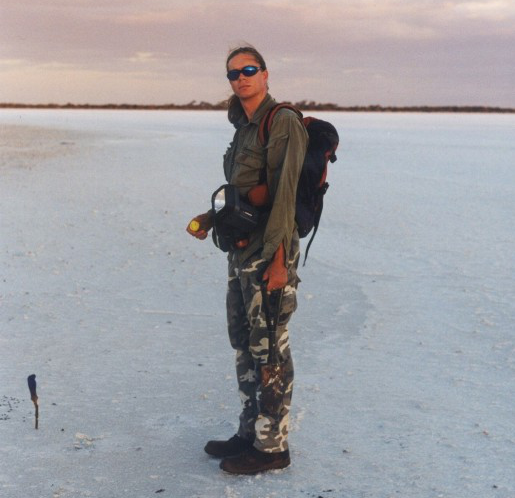
Erich Volschenk undertaking field survey at Lake Lefroy, 1998